
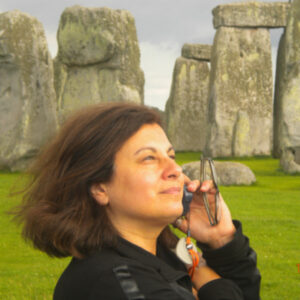
Professional profile
Etruscan archaeologist | Specialist in funerary archaeology | Digital archaeology expert
Etruscan archaeologist specializing in the socio-cultural dynamics of central Italian communities, with a focus on the social dimension of funerary practices, territorial organization, and resource-exploitation strategies in protohistoric and archaic Etruria. She directs the project “Veii. Between Protohistory and History” and the editorial series “Veii and Its Necropolises”, aimed at providing an integrated and up-to-date interpretation of the available evidence through an approach that combines the analysis of identity construction in funerary rituals, their development over time, and the study of material culture. She has directed, since 2025, investigations in an area of the necropolis that is unknown in the literature and had never been previously explored, located in the Agrifoglio locality and dating to a period between the Late Iron Age and the beginning of the Orientalizing period.
Another line of research focuses on the narrative nature of cultural heritage and on the semantic potential and agency of objects, assemblages, architectures, structures, and human-shaped landscapes, all of which generate mental images and participatory experiences closely akin to those elicited by oral storytelling, while also contributing to the formation of cultural memory. Viewed as “visual narratives,” the products of human action serve to convey symbolic meanings, disseminate them, and facilitate their acquisition and retention, forging a strong connection between “showing” and “knowing.”
Member of the Archaeology in Lazio Research Group, a multidisciplinary team dedicated to advancing the study, protection, and interpretation of the archaeological heritage of the region. The group promotes collaborative research, the development of innovative methodological approaches, and the dissemination of updated scientific data on settlement patterns, material culture, and cultural dynamics from prehistory through the historical periods.
She is a member of the scientific committee of Archeologia e Calcolatori, the first and still most authoritative international forum dedicated to digital archaeology, and is a member of the “Open Data” research group, which advocates for archaeological informatics as a genuinely open, collaborative, and accessible science—conceived as a constellation of tools, methods, and principles capable of renewing how archaeological data are produced, managed, and shared.
CNR Disciplinary Fields and Research Management Sectors
- SH6_3 Archaeology of early literate societies and early civilizations (prioritary)
- SH6_2 Prehistoric archaeology, archaeology of non-literate societies
- SH6_6 Digital, computational, virtual and geospatial archaeologies
MUR Italian Scientific-Disciplinary Sector
- ARCH-01/C Pre-Roman Italian Civilization and Etruscology
- ARCH-01/A Prehistory and Protohistory
- ARCH-01/G Archaeological Research Methods
Groups & Labs CNR ISPC
Open data Gruppo di Ricerca →
Archeology in Lazio Research Group →
Publications
Highlight
A. Piergrossi, La necropoli di Poggio Montano: un sito di frontiera nell’Etruria interna (Mediterranea, suppl. 3), Roma 2022. CNR Edizioni. Codice ISBN 978 88 8080 514 4.
A. Piergrossi, La nascita di Veio alla luce dei recenti rinvenimenti, in A. Piergrossi, A. Babbi, M. Cultraro (edd.), Tra Protostoria e Storia: l’Etruria nel cuore del Mediterraneo. Scritti in onore di Filippo Delpino per il suo 80° compleanno (Mediterranea, Suppl. 2), pp. 151-169, Roma 2022. CNR Edizioni. ISBN 978-88-5491-260-1.
A. Piergrossi, What is F.A.I.R.?, in «Archeologia e Calcolatori» 31.1, 2020, pp. 253-257. Edizioni del Giglio. ISSN 1120-6861, ISSN 2385-1953. DOI: https://dx.doi.org/10.19282/ac.31.1.2020.12